Active and passive voice are two different ways of looking at the action of the
sentence. This can take place in any tense (present tense, simple past
tense, perfect tense etc.).
|
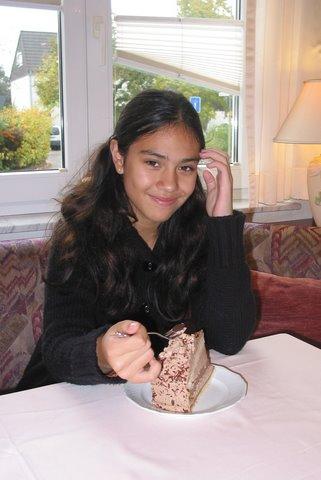
In the active voice, the subject plays an active role
in the sentence. Imagine the sentence is represented by a picture. You see
the subject performing the action.
Das Mädchen
isst ein Stück Sahnetorte.
(The girl is
eating a piece of cream cake.)
Das Mädchen isst den Kuchen.
(The girl is eating the cake.) |
 |
|
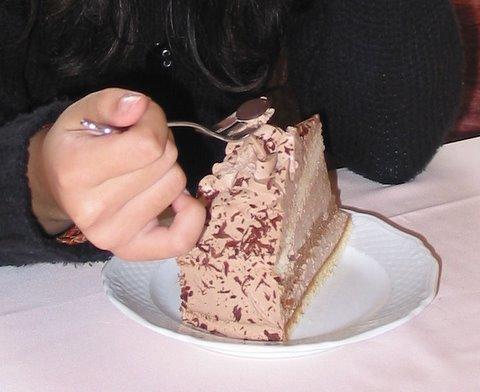
In the passive voice, the original subject who performs
the action is taken out of the picture.
Instead the emphasis is on
the occurrence of the action.
The subject of a passive sentence doesn’t do anything,
it plays a passive role, in that something is done to it.
Ein Stück
Sahnetorte wird gegessen.
(A piece of
cream cake is being eaten.)
Der Kuchen
wird gegessen.
(The cake is
being eaten.)
In other words, the direct object of the active sentence has become
the subject of the passive sentence. |
 |
There is a way of mentioning the original subject in a sentence in the
passive voice and that is with the preface "von + dative":
Ein Stück Sahnetorte wird von dem Mädchen
gegessen.
(A piece of cream cake is being eaten
by the girl.)
Note: If the original subject wasn’t
a person, you use "durch + accusative" instead of "von + dative", e.g.
Das Haus wurde 1877 durch einen
Sturm zerstört.
(The house was destroyed by a storm
in 1877.)
To form the passive voice in English you use the
conjugated form of "to be" plus the past participle,
whereas in
German you use the conjugated form of "werden"
plus the past participle, i.e. in German, things "become", "became"
or "will become done".
Here is an example of a sentence in the passive voice in the various
tenses. Most sentences in the passive voice are either in the present tense
or in the simple past tense.
|
English |
German |
|
present tense |
The house is (being)
built in summer.
The houses are (being) built in summer. |
Das Haus wird im Sommer gebaut.
Die Häuser werden im Sommer gebaut. |
|
simple past tense |
The house was built in
1900.
The houses were built in 1900. |
Das Haus wurde 1900
gebaut.
Die Häuser wurden 1900 gebaut. |
|
perfect tense |
The house has just been
built. The houses have just been built. |
Das Haus ist gerade
gebaut
worden.* Die Häuser sind gerade gebaut worden.* |
|
past perfect tense |
The house had
already been built.
The houses had already been built. |
Das
Haus war schon gebaut
worden.*
Die Häuser waren schon gebaut worden.* |
|
future tense |
The house will be built
next year.
The houses will be built next year. |
Das Haus
wird nächstes Jahr gebaut werden.
Die Häuser werden nächstes gebaut
werden. |
* Note: the actual past participle of "werden"
is "geworden", but in the passive voice the "ge-" is being dropped.
Remember: In German, the conjugated verb is always the second element in
a main clause. If there are other verbs in the clause, they are at the end
of that clause, e.g. |