Active and passive voice are not tenses (present tense, simple past tense,
perfect tense etc. ), but two different ways of looking at the action of the
sentence. This can take place in any tense.
|
In the active voice, the subject plays an active role
in the sentence. Imagine the sentence is represented by a picture. You see
the subject performing the action.
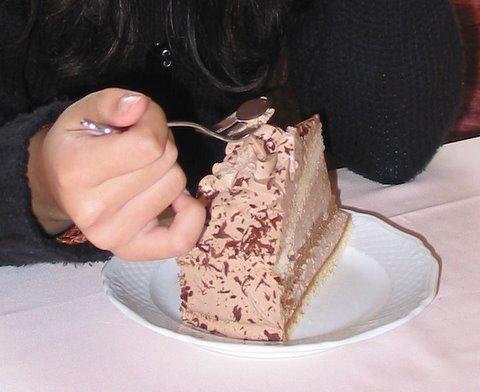
Das Mädchen
isst ein Stück Sahnetorte.
(The girl is
eating a piece of cream cake.)
Das Mädchen isst den Kuchen.
(The girl is eating the cake.) |

|
|
In the passive voice, the original subject who performs
the action is taken out of the picture.
Instead the emphasis is on
the occurrence of the action.
The subject of a passive sentence doesn’t do anything,
it plays a passive role, in that something is done to it.
Ein Stück
Sahnetorte wird gegessen.
(A piece of
cream cake is being eaten.)
Der Kuchen
wird gegessen.
(The cake is
being eaten.)
In other words, the direct object of the active sentence has become
the subject of the passive sentence. |
 |
There is a way of mentioning the original subject in a sentence in the
passive voice and that is with the preface "von + dative":
Ein Stück Sahnetorte wird von dem Mädchen
gegessen.
(A piece of cream cake is being eaten
by the girl.)
Note: If the original subject wasn’t
a person, you use "durch" + accusative instead of "von" + dative, e.g.
Das Haus wurde 1877 durch
einen
Sturm zerstört.
(The house was destroyed by a storm
in 1877.)
To form the passive voice in English you use the
conjugated form of "to be" plus the past participle,
whereas in
German you use the conjugated form of "werden"
plus the past participle, i.e. in German, things "become", "became"
or "will become done".
Here is an example of a sentence in the passive voice in the various
tenses. Most sentences in the passive voice are either in the present tense
or in the simple past tense.
|
English |
German |
|
present tense |
The house is (being)
built in summer.
The houses are (being) built in summer. |
Das Haus wird im Sommer gebaut.
Die Häuser werden im Sommer gebaut. |
|
simple past tense |
The house was built in
1900.
The houses were built in 1900. |
Das Haus wurde 1900
gebaut.
Die Häuser wurden 1900 gebaut. |
|
perfect tense |
The house has just been
built. The houses have just been built. |
Das Haus ist gerade
gebaut
worden.* Die Häuser sind gerade gebaut worden.* |
|
past perfect tense |
The house had
already been built.
The houses had already been built. |
Das
Haus war schon gebaut
worden.*
Die Häuser waren schon gebaut worden.* |
|
future tense |
The house will be built
next year.
The houses will be built next year. |
Das Haus
wird nächstes Jahr gebaut werden.
Die Häuser werden nächstes gebaut
werden. |
* Note: the actual past participle of "werden"
is "geworden", but in the passive voice the "ge-" is being dropped.
Remember: In German, the conjugated verb is always the second element in
a main clause. If there are other verbs in the clause, they are at the end
of that clause, e.g. |
|
Das Haus |
wurde |
im Jahr 1900 |
gebaut. |
|
Im Jahr 1900 |
wurde |
das Haus |
gebaut. |
| |
|
|
|
|
Das Haus |
wird |
nächstes Jahr |
gebaut werden |
|
Nächstes Jahr |
wird |
das Haus |
gebaut werden. |
Passive voice is more common in German than in
English.
It can be used also with the impersonal subject "es",
e.g.
Es wird wieder
gearbeitet. (Work is being done again.)
This "es" can even disappear when there are expressions of time, place
or manner at the beginning of the sentence, e.g.
Am
Montagmorgen wird wieder gearbeitet. (Work will be done again on Monday
morning.)
or
In der Fabrik
wird wieder gearbeitet. (Work is being done again in the factory.)
Passive voice with modal verbs
This
is used to say that something can/should/is supposed to /must/ought to /may
(not) be done.
It is formed by using the conjugated
modal verb
+ the past participle + the
infinitive of "werden".
The passive voice with modal verbs is mainly used in the present
tense, in the past tense and in the subjunctive. |
|
|
conjugated modal verb |
|
past participle |
infinitive of "werden" |
English equivalent |
|
present tense |
Die Betten |
sollen |
bis
Mittag |
gemacht |
werden. |
The beds should be made
before lunchtime. |
|
simple past tense |
Das Gerät |
konnte |
nicht |
repariert |
werden. |
The appliance couldn’t be repaired. |
|
subjunctive |
Das |
müsste |
noch heute |
abgeschickt |
werden. |
That would have to be sent out
by today. |
Alternatives to the passive voice with modal verbs
1. The passive voice with the modal verbs "müssen", "können", "sollen"
and "nicht
dürfen" can be replaced with the conjugated form of the verb "sein" + "zu" +
the infinitive of the full verb, e.g.
|
passive voice with modal verbs |
conjugated
form of
"sein" + "zu" +
infinitive of the full
verb |
| Die Geräte müssen regelmäßig
gewartet werden |
Die Geräte
sind regelmäßg
zu
warten. |
| Der Deckel der Dose konnte leicht
geöffnet werden. |
Der Deckel der Dose
war leicht
zu
öffnen. |
| Die Masken sollen nach einmaliger
Nutzung entsorgt werden. |
Die Maske
sind nach einmaliger Nutzung
zu
entsorgen. |
| Die Gefahr darf nicht unterschätzt
werden. |
Die Gefahr
ist nicht
zu
unterschätzen. |
2. The passive voice with the modal verb "können" can be
replaced with the conjugated form of "sein" and the adjective ending
in "-bar" that was derived of the full verb, e.g.
|
passive voice with the modal verb "können" |
full verb |
conjugated
form of
"sein" +
adjective endng in "-bar"
which was derived of the full verb |
|
Die Jacke kann bei 30 C gewaschen werden. |
waschen |
Die
Jacke
ist bei 30 C
waschbar. |
| Die
Becher können recycelt werden. |
recyceln |
Die
Becher
sind
recycelbar. |
|
Das konnte nicht gemacht werden. |
machen |
Das
war nicht
machbar. |
3. The passive voice with the modal verb "können" can be
replaced with the conjugated form of "sich lassen" and the infinitive
of the full verb, e.g.
|
passive voice with the modal verb "können" |
conjugated
form of "sich lassen" +
infinitive
of the full verb |
| Das
kann gemacht werden. |
Das
lässt sich
machen. |
| Die
Schuhe können natürlich neu besohlt werden. |
Die Schuhe
lassen sich natürlich neu
besohlen. |
|
Das Zelt konnte in kurzer Zeit ohne Probleme aufgebaut werden. |
Das
Zelt
ließ sich in kurzer Zeit ohne Problme
aufbauen. |